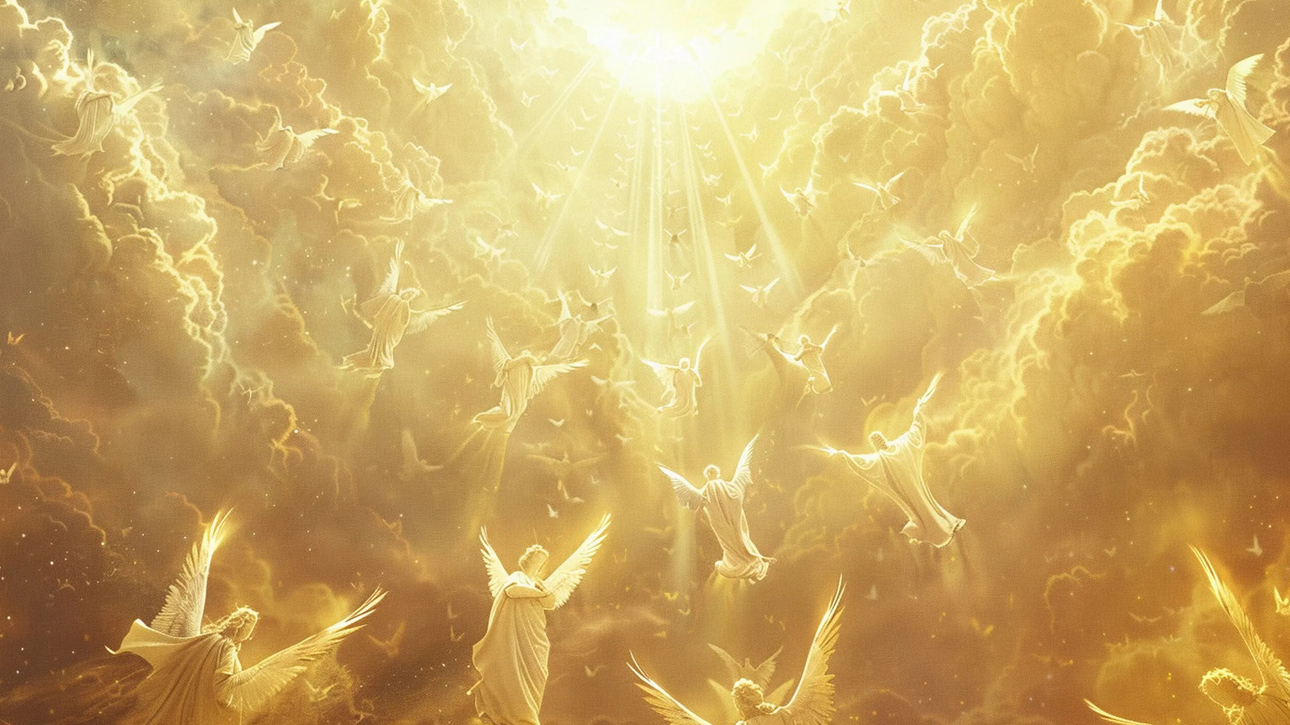
Week 7 of 10: The Questions That Change Everything
Over the past six weeks, we have journeyed together through questions that have challenged us to look more deeply into the pages of Scripture.
We have explored the unseen realm.
We have examined ancient writings mentioned in the Bible.
We have considered Enoch and his remarkable place in biblical history.
We have asked whether evil began before humanity.
We have looked at the Garden of Eden as more than simply humanity’s starting point.
And last week we reflected on what it truly means to be created in the image of God.
Each question has reminded us that the Bible is far richer than many of us first imagined.
Today we arrive at one of the most debated questions in biblical study.
One that has generated discussion for centuries.
One that deserves to be approached with humility, careful study, and respect for God’s Word.
What if angels and the “sons of God” are not the same?
At first, many people assume these terms describe the same beings.
After all, both belong to the unseen realm.
Both appear throughout Scripture.
Both serve God’s purposes.
But when we slow down and read carefully, we discover something interesting.
The Bible does not always use the same language for every heavenly being.
Could there be a reason?
Words Matter
One of the first principles of studying Scripture is allowing the Bible to speak in its own language.
When different words are consistently used, thoughtful readers ask why.
Throughout the Old Testament we encounter the phrase “sons of God.”
In places such as Genesis 6 and the opening chapters of Job, this phrase appears in ways that have intrigued scholars for generations.
In other passages we read of angels—messengers sent by God to deliver His word, protect His people, or carry out His purposes.
The question naturally arises:
If Scripture wanted us to think they were always identical, why use different descriptions?
The Heavenly Court
One of the fascinating scenes in Scripture occurs in the opening chapters of Job.
There we read that the “sons of God” present themselves before the Lord.
Among them comes Satan.
The scene is striking.
It portrays order.
Authority.
Government.
Deliberation.
This is not chaos.
It is a heavenly court.
The language suggests participation within God’s heavenly administration.
Again, thoughtful readers ask:
Why this description?
Angels: God’s Messengers
Throughout both the Old and New Testaments, angels consistently appear with specific assignments.
They announce births.
Protect God’s people.
Deliver warnings.
Strengthen prophets.
Minister to Jesus.
Roll away the stone from the empty tomb.
The very word “angel” emphasizes function.
They are messengers.
Servants carrying out God’s will.
Their purpose is beautifully clear.
The “Sons of God”: A Different Emphasis?
Now let us ask the question carefully.
Could the phrase “sons of God” emphasize something different?
Some scholars believe it refers to members of God’s heavenly court.
Others understand it differently.
Faithful believers have reached different conclusions throughout history.
What is important is not forcing certainty where Scripture leaves room for discussion.
It is recognizing that the biblical writers intentionally used language that invites careful thought.
Whatever one’s conclusion, these passages remind us that heaven is not portrayed as empty.
It is presented as a kingdom.
A place of order.
Purpose.
Authority.
And worship.
Genesis 6: One of Scripture’s Most Difficult Passages
No discussion of the “sons of God” can ignore Genesis 6.
There we read:
“The sons of God saw that the daughters of humans were beautiful, and they married any of them they chose.”
Few passages have generated more discussion.
Some understand the passage as describing heavenly beings crossing boundaries established by God.
Others interpret it as referring to the descendants of Seth intermarrying with the descendants of Cain.
Still others offer different explanations entirely.
The purpose of this series is not to settle every debate.
Rather, it is to encourage careful reading and thoughtful reflection.
What we should all agree upon is that Genesis 6 introduces a serious corruption that grieves the heart of God and sets the stage for the coming flood.
Why Does This Matter?
Some might wonder why any of this deserves attention.
The answer is simple.
Because how we understand the unseen realm shapes how we understand the Bible.
The biblical authors clearly believed that heaven is populated.
That spiritual beings exist.
That God’s kingdom includes both visible and invisible realities.
Recognizing this helps us read Scripture through the worldview of its original writers instead of forcing modern assumptions onto ancient texts.
Humility Is Essential
Questions like these remind us of something important.
Not every sincere Christian will agree on every interpretation.
That is true throughout church history.
Humility allows us to explore difficult passages without becoming dogmatic where Scripture itself leaves room for discussion.
Our confidence must always rest in what Scripture clearly teaches.
Our curiosity should always remain submitted to God’s Word.
The goal is never to win arguments.
The goal is to know God more fully.
The Greater Lesson
Perhaps the greatest lesson hidden within this discussion is not the identity of heavenly beings.
Perhaps it is this:
Creation is far richer than we often imagine.
God’s kingdom extends beyond what our eyes can see.
The Bible invites us to lift our eyes beyond the physical and recognize that reality is both visible and invisible.
As the Apostle Paul reminds us:
“For the things which are seen are temporary, but the things which are not seen are eternal.”
The unseen realm is not meant to distract us from Christ.
It is meant to deepen our awe of the God who reigns over all creation.
The Question Beneath the Question
Perhaps the deeper question is not:
“Are angels and the sons of God different?”
Perhaps the deeper question is:
“How much of God’s creation have we overlooked simply because we have stopped asking questions?”
Sometimes the greatest discoveries are not found by inventing new ideas.
Sometimes they come from reading familiar passages with fresh eyes.
Your Turn
As you read the Bible, have you ever noticed terms that seemed similar but perhaps carried different meanings?
How important do you think it is to study Scripture within the worldview of the people who first received it?
I’d love to hear your thoughts.
Next Week
Next week we continue our journey with another question that has inspired believers throughout the centuries:
What If Prophecy Is More Layered Than We Realize?
Could biblical prophecy speak to more than one generation?
Could some prophecies unfold in stages, revealing God’s purposes across history?
Together, we’ll explore how God’s Word continues to reveal His plan with remarkable depth and precision.
Thanks.