What If the Sons of God in Genesis Six Were Heavenly Beings?
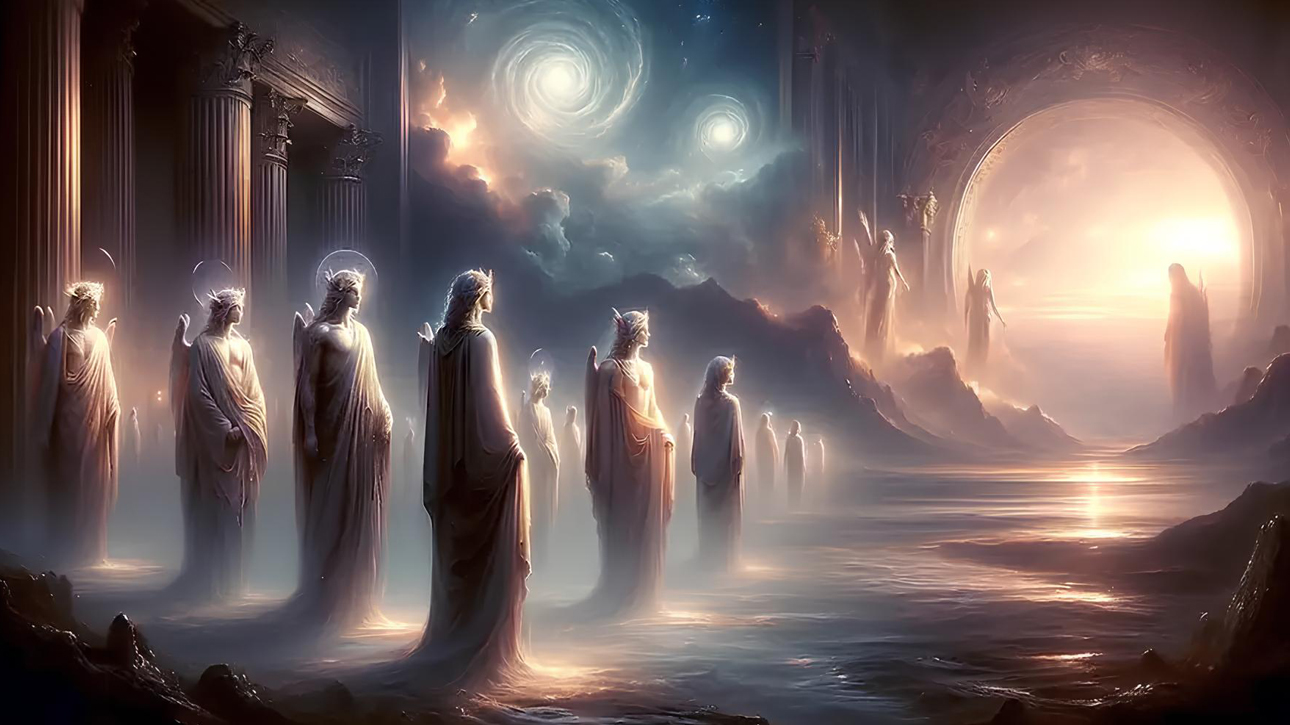
WHAT IF BLOG SERIES | EPISODE 18
By Carl Schulz | Insight Ministry
And What If Genesis Is Describing More Than Human Rebellion?
Last week we explored a question that can make some Christians uncomfortable:
What if the Book of Enoch helps us understand parts of the Bible?
Not because Enoch should replace Scripture.
Not because every statement contained in an ancient writing must automatically be treated as inspired.
But because writings from the biblical world can sometimes help us understand what biblical writers—and their original audiences—already knew.
And that discussion brought us directly to a question waiting in Genesis chapter six:
Who were the “sons of God”?
For many of us, Genesis six was read quickly.
We knew Noah was coming.
We knew the flood was coming.
We knew humanity had become desperately wicked.
So we hurried through the strange opening verses to get to the story we understood.
But perhaps we have been reading too quickly.
Because before Scripture tells us about Noah…
before it describes the ark…
and before the waters of judgment begin to rise…
Genesis tells us something extraordinary happened.
Something involving the sons of God, the daughters of men, and beings called the Nephilim.
What if that isn’t a strange side note?
What if it helps explain what had gone terribly wrong with God’s creation?
Read the Passage Again
Genesis tells us:
“When human beings began to increase in number on the earth and daughters were born to them, the sons of God saw that the daughters of humans were beautiful, and they married any of them they chose.”
— Genesis 6:1–2 (NIV)
Then comes an even stranger statement:
“The Nephilim were on the earth in those days—and also afterward—when the sons of God went to the daughters of humans and had children by them.”
— Genesis 6:4 (NIV)
Stop there.
Forget for a moment what someone told you the passage means.
Simply ask what the text appears to be saying.
There are daughters of humans.
There are sons of God.
And something happens between them that Genesis connects with the appearance of unusual offspring.
Why does the writer distinguish between the two groups?
And who exactly are these “sons of God”?
That question matters.
The Explanation Many of Us Were Given
Many Christians have been taught that the sons of God were simply human beings—often identified as descendants of Seth—and that the daughters of men were descendants of Cain.
According to this interpretation, Genesis six is describing godly men marrying ungodly women.
That interpretation has a long history within Christianity.
And we should treat it respectfully.
But there is a problem.
Genesis never actually calls the descendants of Seth “sons of God.”
Nor does Genesis six identify the women as descendants of Cain.
Those identifications are supplied by the interpretation, not explicitly by the passage itself.
That doesn’t automatically make the interpretation wrong.
But it should cause us to ask:
Is there another biblical way to understand the phrase “sons of God”?
There is.
And this is where things become fascinating.
The Sons of God Appear Somewhere Else
The Hebrew expression commonly translated “sons of God” appears elsewhere in the Old Testament.
One of the clearest examples is in the Book of Job.
Job begins with a scene that does not take place on earth.
It takes place in the heavenly court.
We read:
“One day the angels came to present themselves before the LORD, and Satan also came with them.”
— Job 1:6 (NIV)
The NIV translates the phrase here as “angels,” while other translations render the underlying Hebrew more literally as “sons of God.”
Whatever English translation we choose, the setting is unmistakable.
These beings are presenting themselves before God.
The scene is heavenly.
The same type of language appears again in Job chapter two.
And then something even more interesting happens later in Job.
When God describes the creation of the earth, He asks Job:
“Where were you when I laid the earth’s foundation?… while the morning stars sang together and all the angels shouted for joy?”
— Job 38:4, 7 (NIV)
Again, many translations render the Hebrew expression as “sons of God.”
And notice when this occurs.
These beings are rejoicing when God lays the foundations of the earth.
Humanity hasn’t appeared yet.
Adam hasn’t been formed.
Seth hasn’t been born.
Cain hasn’t been born.
There are no human family lines.
Yet the sons of God are already there.
That should at least make us reconsider the assumption that the same expression in Genesis six must refer to ordinary human men.
What If the Ancient Reader Understood This Immediately?
This is where our previous discussion about Enoch becomes important.
We are reading Genesis thousands of years after its ancient cultural world.
Its earliest readers lived much closer to traditions, expressions, and ideas that are unfamiliar to us.
Sometimes Scripture says very little about something because its original audience apparently did not require a lengthy explanation.
Imagine someone writing today:
“The President entered the Oval Office.”
An American reader doesn’t need the author to stop and explain what the Oval Office is, where it is located, or why the President would be there.
We already understand the context.
But imagine someone reading that sentence three thousand years from now after nearly all knowledge of American government had disappeared.
They might have questions we never considered necessary to answer.
Perhaps something similar happens when we read Genesis six.
The writer says:
“the sons of God…”
And keeps moving.
Maybe the ancient audience already understood the expression.
Perhaps we are the ones who have lost the context.
This Is Where Enoch Becomes Valuable
First Enoch expands dramatically upon the mysterious events surrounding Genesis six.
It describes heavenly beings often called Watchers who abandon their proper place, descend to earth, take human women, and produce destructive offspring.
Again, that does not mean we must automatically accept every detail of Enoch as Scripture.
That is not the point.
The important question is historical:
Does Enoch preserve an ancient Jewish understanding of Genesis six?
Clearly, it does.
And suddenly something else in our New Testament becomes extremely interesting.
Jude writes:
“And the angels who did not keep their positions of authority but abandoned their proper dwelling—these he has kept in darkness, bound with everlasting chains for judgment on the great Day.”
— Jude 6 (NIV)
Then Peter writes:
“For if God did not spare angels when they sinned, but sent them to hell, putting them in chains of darkness to be held for judgment…”
— 2 Peter 2:4 (NIV)
Peter immediately moves from these sinning angels to Noah and the flood.
That sequence deserves our attention.
Angelic rebellion.
Judgment.
Noah.
Flood.
Why?
Could Peter and Jude be drawing from the same ancient understanding of Genesis six reflected in Enoch?
At the very least, the connection deserves serious consideration.
What Exactly Was the Sin?
If the heavenly-being interpretation is correct, Genesis six describes something far more serious than inappropriate marriages.
It describes a violation of boundaries established by God.
Heavenly beings crossed into a realm they were not authorized to enter in that manner.
Jude’s wording is especially striking:
They “abandoned their proper dwelling.”
Something crossed a boundary.
Something left its appointed place.
Something corrupted the created order.
And the consequences were catastrophic.
This would mean the opening verses of Genesis six are not disconnected from what follows.
They are part of the explanation for why the world had become so corrupted.
Genesis continues:
“The LORD saw how great the wickedness of the human race had become on the earth, and that every inclination of the thoughts of the human heart was only evil all the time.”
— Genesis 6:5 (NIV)
We normally read that entirely as a story of human wickedness.
And human wickedness is certainly present.
But what if Genesis is describing two rebellions operating together?
Human rebellion from below.
And spiritual rebellion from above.
That changes the landscape considerably.
The Bible’s Story May Be Bigger Than We Realized
One of the ideas we keep encountering throughout this What If? journey is that Scripture describes reality as larger than the physical world visible around us.
There is an earthly realm.
And there is a heavenly realm.
There are human beings.
And there are spiritual beings.
There is human rebellion.
And Scripture also describes spiritual rebellion.
Perhaps we have sometimes reduced the biblical story because we have concentrated almost entirely upon the human side.
But the Bible repeatedly pulls back the curtain.
Job shows us a heavenly council.
Daniel shows us spiritual powers associated with earthly kingdoms.
The Gospels show Jesus confronting demons.
Paul speaks of rulers, authorities, powers, and spiritual forces of evil in heavenly realms.
Revelation describes war in heaven.
The biblical world is filled with interaction between the visible and invisible.
So why would Genesis be different?
And Then There Are the Nephilim
Genesis introduces another mystery:
the Nephilim.
Who were they?
Genesis gives us very little explanation.
It simply says:
“The Nephilim were on the earth in those days—and also afterward…”
— Genesis 6:4 (NIV)
That phrase—
“and also afterward”
—should immediately make the curious reader pause.
Afterward when?
After the events being described?
After the flood?
And if the Nephilim are connected somehow with the later giants encountered in the biblical story, then another question emerges:
Why do unusual giant clans appear again later in Scripture?
When Israel approaches the Promised Land, the spies return terrified.
They report seeing unusually large inhabitants.
Numbers tells us:
“We saw the Nephilim there… We seemed like grasshoppers in our own eyes, and we looked the same to them.”
— Numbers 13:33 (NIV)
Whatever we conclude about the spies’ frightened report, the terminology is remarkable.
The word has returned.
And later biblical history contains repeated references to unusually large warrior clans.
Anakim.
Rephaim.
And eventually one individual almost everyone knows:
Goliath.
Are these stories connected?
Maybe.
Maybe not in every detail.
But once again, the Bible gives us enough information to make us ask questions without giving us enough information to answer every one of them easily.
And perhaps that is intentional.
Why Would This Matter Today?
Someone may reasonably ask:
Carl, why does any of this matter?
What difference does the identity of the sons of God make to someone trying to follow Jesus today?
Perhaps more than we think.
Because this isn’t ultimately a discussion about giants.
It is a discussion about the scope of the biblical story.
If Genesis six involves rebellious heavenly beings, then evil in Scripture is not presented merely as bad human behavior.
There is a larger conflict.
Human beings are responsible for our choices.
But we are living within a story involving realities greater than ourselves.
Paul writes:
“For our struggle is not against flesh and blood, but against the rulers, against the authorities, against the powers of this dark world and against the spiritual forces of evil in the heavenly realms.”
— Ephesians 6:12 (NIV)
Paul apparently believed the conflict surrounding God’s people extended beyond what human eyes could see.
Maybe Genesis was telling us that from almost the beginning.
But We Must Be Careful
There is another side to this conversation.
Curiosity without discipline can become speculation.
And speculation can quickly become sensationalism.
That is not what this journey is about.
We do not need to invent elaborate stories where Scripture remains silent.
We don’t need to turn every unexplained archaeological discovery into evidence of Nephilim.
We don’t need to see demons hiding behind everything we don’t understand.
And we certainly don’t need fear.
Our goal is simpler.
Read carefully.
Ask honestly.
Study historically.
Compare Scripture with Scripture.
And when ancient writings can help us understand the intellectual world surrounding the Bible, examine them carefully without confusing them with the authority we assign to Scripture.
There is a difference between saying:
“This ancient source helps us understand what people believed.”
and saying:
“Everything this ancient source says must therefore be true.”
Those are not the same statement.
Responsible exploration knows the difference.
Perhaps the Real Danger Is Assuming We Already Know
This brings us back to the heart of the What If? journey.
Sometimes we approach Scripture already knowing what it is allowed to say.
We inherited an interpretation.
We heard it in Sunday school.
We heard it from a pastor.
We read it in a study Bible.
And eventually the interpretation became so familiar that we stopped distinguishing it from the actual words on the page.
But inherited interpretation and Scripture are not always identical.
That does not mean our teachers were dishonest.
It doesn’t mean the Church failed.
It simply means every generation must return to the text.
Read it again.
Examine it again.
Ask the questions again.
Because truth does not need protection from investigation.
Truth can withstand our questions.
So… What If?
What if the sons of God in Genesis six really were heavenly beings?
What if some members of God’s heavenly order rebelled against the boundaries He established?
What if Genesis six records not merely increasing human wickedness, but an intersection between human rebellion and spiritual rebellion?
What if Enoch preserves part of the ancient interpretive background that helps us understand why Jude and Peter could refer to rebellious angels without stopping to explain the entire story?
And what if the Nephilim are part of a biblical thread that continues farther into the Old Testament than most of us ever noticed?
None of those questions requires us to abandon Scripture.
They require us to look more closely at Scripture.
And that is exactly what we are trying to do.
Not tear the Bible apart.
Not chase mysteries merely because they are mysterious.
But allow Scripture to be as large, strange, beautiful, supernatural, and extraordinary as its own writers present it.
Because once we acknowledge that Genesis may be describing a rebellion involving the heavenly realm, another question immediately follows.
Perhaps an even larger one.
If rebellion existed among heavenly beings…
when did that rebellion actually begin?
Was Genesis six the beginning of spiritual rebellion?
Or had something already happened before Eden?
Before the serpent approached Eve…
before humanity fell…
before Genesis six…
had war already begun in Heaven?
That is where our journey takes us next.
Next Week — Blog 19
What If Evil Began Before Humanity?
Perhaps the serpent in Eden was not the beginning of the story.
Perhaps he was evidence that another story had already begun.
And if that is true, Genesis chapter three may not introduce the first rebellion at all.
It may introduce the moment when an older rebellion reached humanity.
Until next time, keep your Bible open.
Keep your mind open.
Keep your heart anchored in God.
And keep asking the question that started this entire journey:
What if?